Details
ai / active build
Aurora
A local-first voice assistant that combines wake word, STT, LangGraph tools, RAG memory, TTS, and private mesh architecture.
Live 3D architecture
The scene beside this panel is this system's architecture. Drag to rotate, scroll panel to read on.
Problem
Most assistants become either cloud-dependent black boxes or local demos that break down once wake word, speech, tools, memory, scheduling, model routing, and multi-device use all have to work together.
Contribution
Designed and built the assistant architecture: wake word, real-time STT, LLM orchestration, plugin/tool loading, MCP integration, local memory, TTS, UI state, and process-mode service deployment.
Architecture
Aurora started as a local assistant and was deliberately separated into service contracts: STT coordinator, transcription, wake word, TTS, orchestrator, DB/RAG, tooling, scheduler, gateway, and supervisor. The same capabilities can run in thread mode through LocalBus or process mode through Redis/BullMQ, with gateway routes generated from typed contracts and mesh routing designed as configuration rather than caller rewrites.
Technical decisions
Tradeoffs
Outcome
A deep AI systems project: voice UX, local privacy, tool orchestration, service contracts, RAG, model-provider flexibility, and distributed mesh architecture all visible in one codebase.
visual evidence · 1/6
Screenshots and UI captures
Screenshots and UI captures for this project.
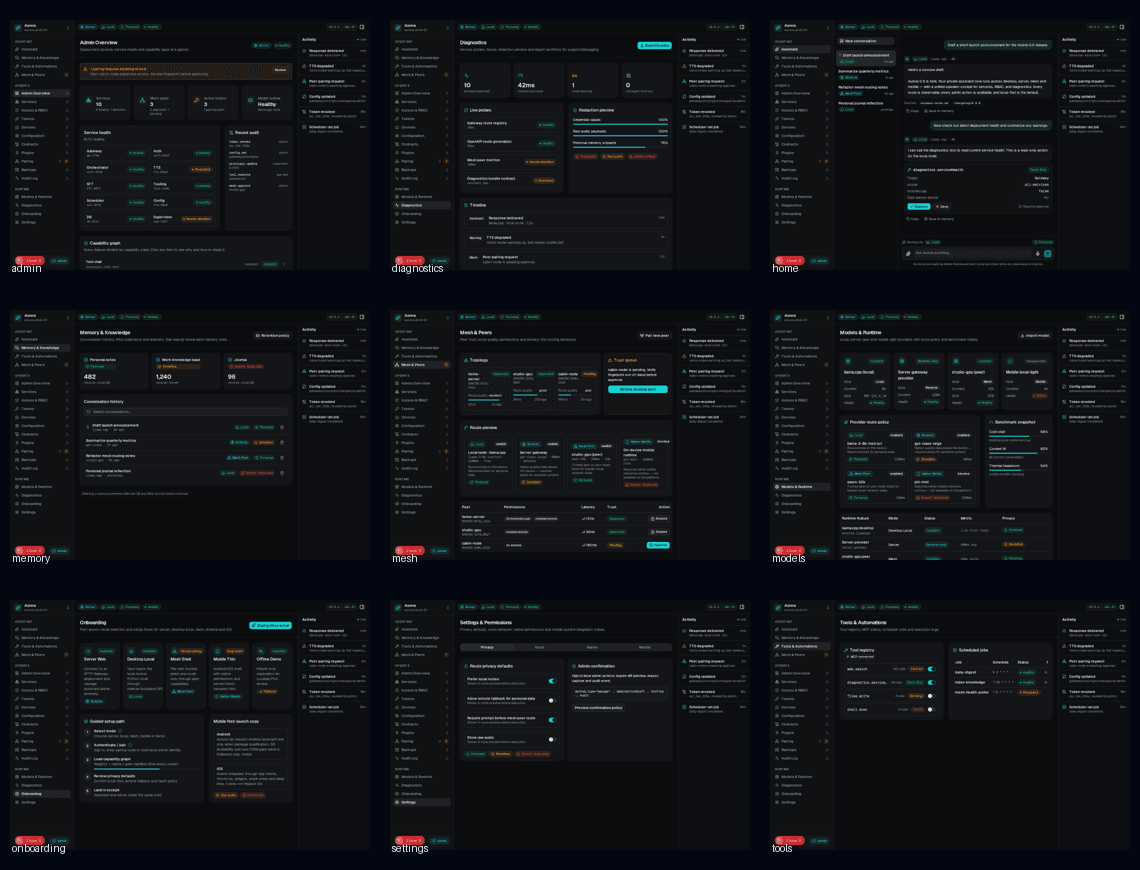
Dark UI contact sheet for Aurora UI surfaces.
Stack and domains
- Python
- LangGraph
- LangChain
- MCP
- Whisper
- OpenWakeWord
- Piper
- SQLite
- Redis
- Docker